
Why Women’s Mental Wellbeing Requires a New Approach
Across the world we are seeing an unprecedented rise in conversations around mental wellbeing. Governments are investing billions. Corporations are implementing wellbeing strategies. Communities are speaking more openly than ever about trauma, burnout and emotional exhaustion – and yet something important is still missing.
Despite the growing number of services, frameworks and interventions, many women continue to feel unheard, unseen and deeply disconnected from themselves. For decades the dominant approach to mental health has been built on Western clinical models. These models have contributed important knowledge and lifesaving interventions, but they have also shaped a narrative that positions people, particularly women, as problems to be fixed rather than whole human beings with innate wisdom.
The Hidden Cost of Disconnection
Women often arrive in healing spaces already carrying the belief that something inside them is broken. They have spent years navigating expectations about who they should be. Strong but not too strong. Caring but not self-sacrificing. Ambitious but not threatening. Many have experienced trauma, grief, systemic barriers, cultural disconnection or economic inequality. Yet instead of exploring these broader realities, traditional models often focus narrowly on symptoms. The result is a system that frequently treats distress without addressing disconnection. For women, disconnection is often the deeper wound.
- Disconnection from voice.
- Disconnection from intuition and innate feminine wisdom.
- Disconnection from community.
- Disconnection from cultural knowledge.
- Disconnection from purpose.
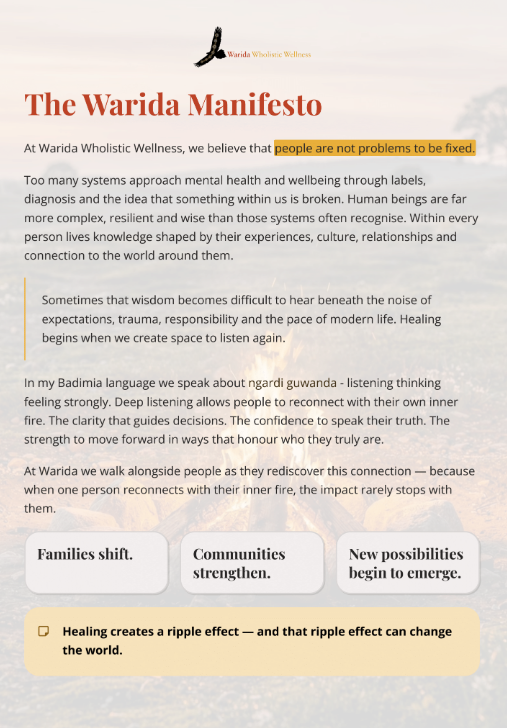
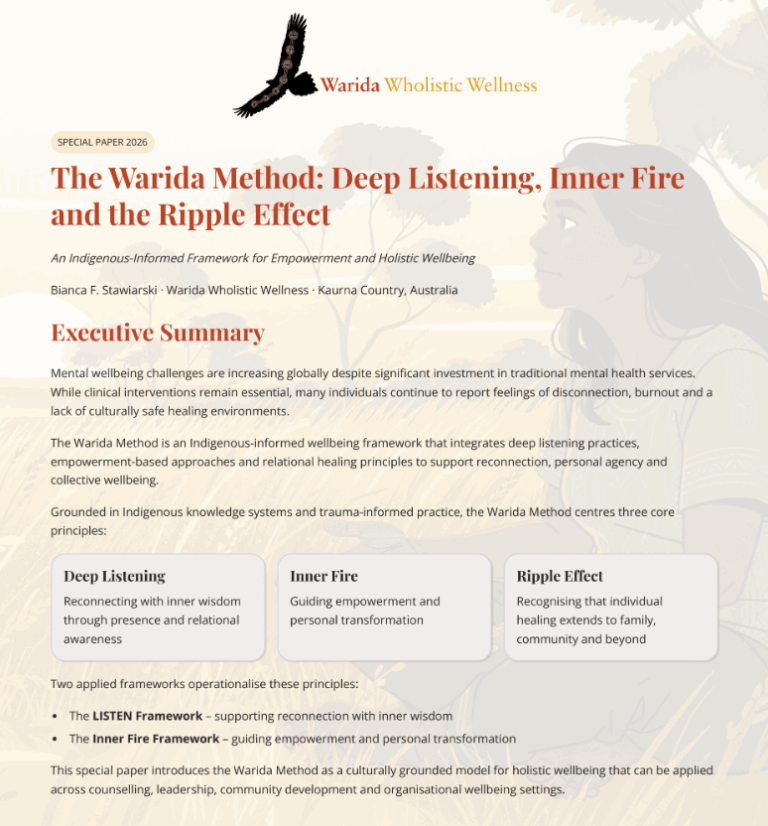
True empowerment begins with reconnection. This is why the future of women’s mental wellbeing must move beyond the idea that healing happens only inside clinical rooms. Healing also happens in relationship. It happens in spaces of trust, where women feel safe to speak honestly without fear of judgement. It happens when women are supported to practise deep listening. In many Indigenous knowledge systems this is understood as a form of listening that goes beyond words. It is listening with mind, heart and spirit. Deep listening allows women to reconnect with something powerful that has often been silenced by external expectations – Their inner fire.
Reclaiming Your Inner Fire
Inner fire represents authenticity, courage and life force. It is the part of a woman that remembers her strength even when systems attempt to diminish it. When women reconnect with this inner fire, transformation begins to occur. They start to question narratives that once felt unquestionable. They begin setting boundaries that protect their wellbeing. They pursue ideas that once felt impossible. They build businesses, advocate for their communities and create opportunities for others. Women’s empowerment is not just about individual success. It is about collective transformation.
The Ripple Effect of Women’s Empowerment
When women heal and step into their power, the ripple effect extends far beyond the individual.
- Families benefit.
- Children grow up witnessing healthy self-worth.
- Communities become stronger and more resilient.
- Economic opportunities expand.
This is why empowerment and wellbeing must be understood as interconnected. Emotional wellbeing cannot be separated from social, cultural and economic empowerment. For many women, particularly First Nations women and women from marginalised communities, empowerment also means reclaiming knowledge systems that have been dismissed or overlooked.
Indigenous Wisdom and Holistic Healing
Indigenous approaches to healing recognise that wellbeing is holistic. Mental, physical, spiritual and community wellbeing are deeply interconnected. Rather than positioning individuals as isolated patients, Indigenous knowledge systems emphasise connection.
- Connection to self.
- Connection to others.
- Connection to Country.
- Connection to story.
- Connection to purpose.
When these connections are strengthened, healing becomes possible in ways that purely clinical models often struggle to achieve. This is not about rejecting Western approaches entirely. Rather, it is about expanding our understanding of what healing can look like.
Why the Future of Healing is Relational
The future of mental wellbeing will be shaped by approaches that are relational, culturally grounded and empowering. Approaches that recognise the wisdom already present within individuals and communities. Approaches that walk alongside people rather than positioning professionals as the sole holders of knowledge.
When women are supported to reconnect with their inner fire, they do not simply recover from distress.
- They become leaders.
- They become creators.
- They become catalysts for change.
Women’s empowerment is not a trend. It is one of the most powerful forces shaping the future of wellbeing – and the most exciting part is this:
The answers we are searching for are not something we need to invent. They already exist within women themselves.
Sometimes the most powerful thing we can offer is not advice, diagnosis or solutions. Sometimes the most powerful thing we can offer is space.
- Space to listen.
- Space to reconnect.
- Space to remember who we truly are.
Because when women are given that space, they rarely just heal. They rise.
Bianca xx